
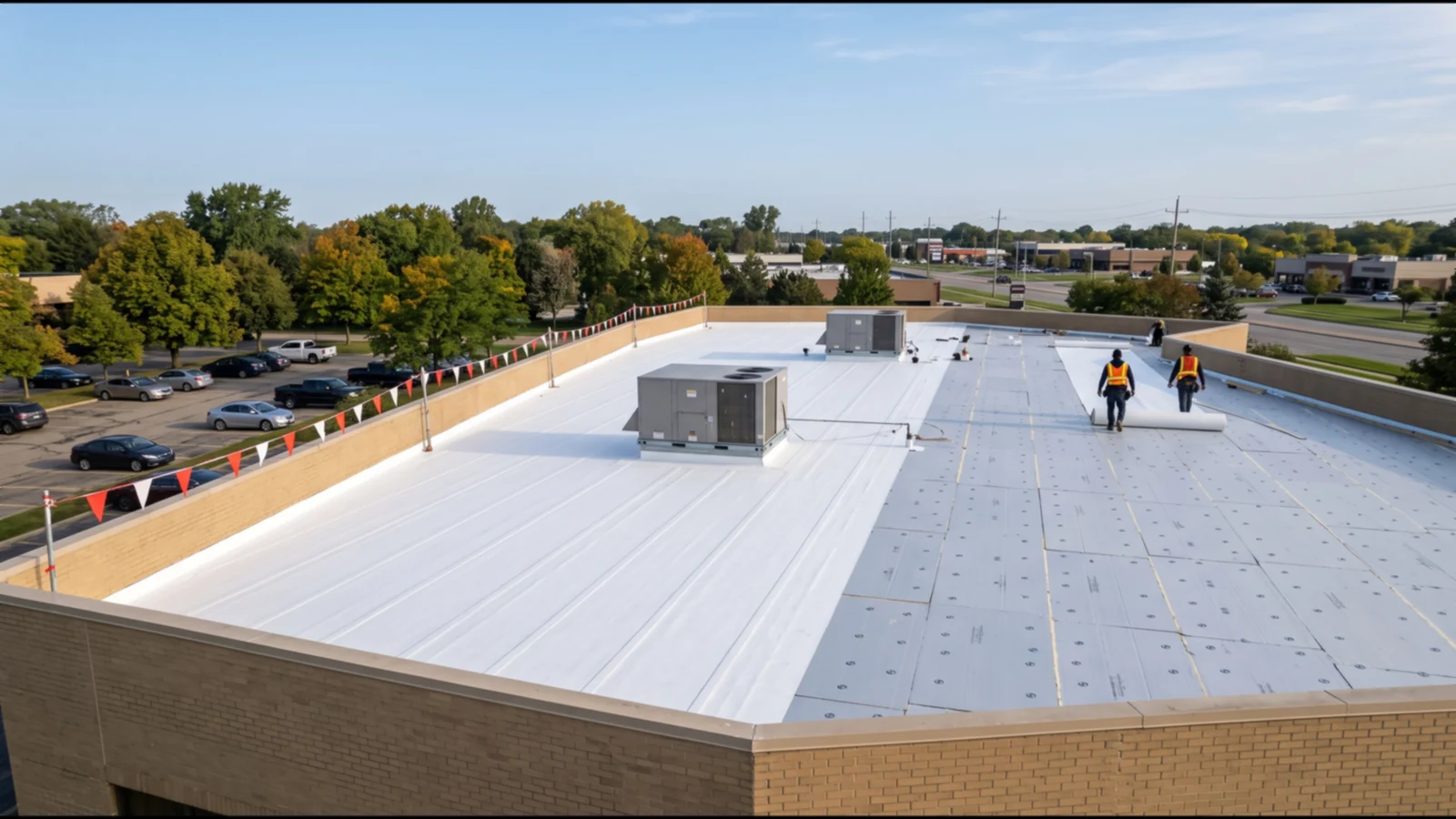
Commercial Roof Coating Types for Troy Buildings
The Roof Coatings Manufacturers Association lists acrylic, asphalt, polyurethane and silicone as the most common coatings, and the building code gives each its own ASTM standard. "Elastomeric" describes the stretchy film most of them cure into rather than a chemistry, so a bid that says only "elastomeric coating" leaves out the fact that matters most.
Silicone Roof Coatings
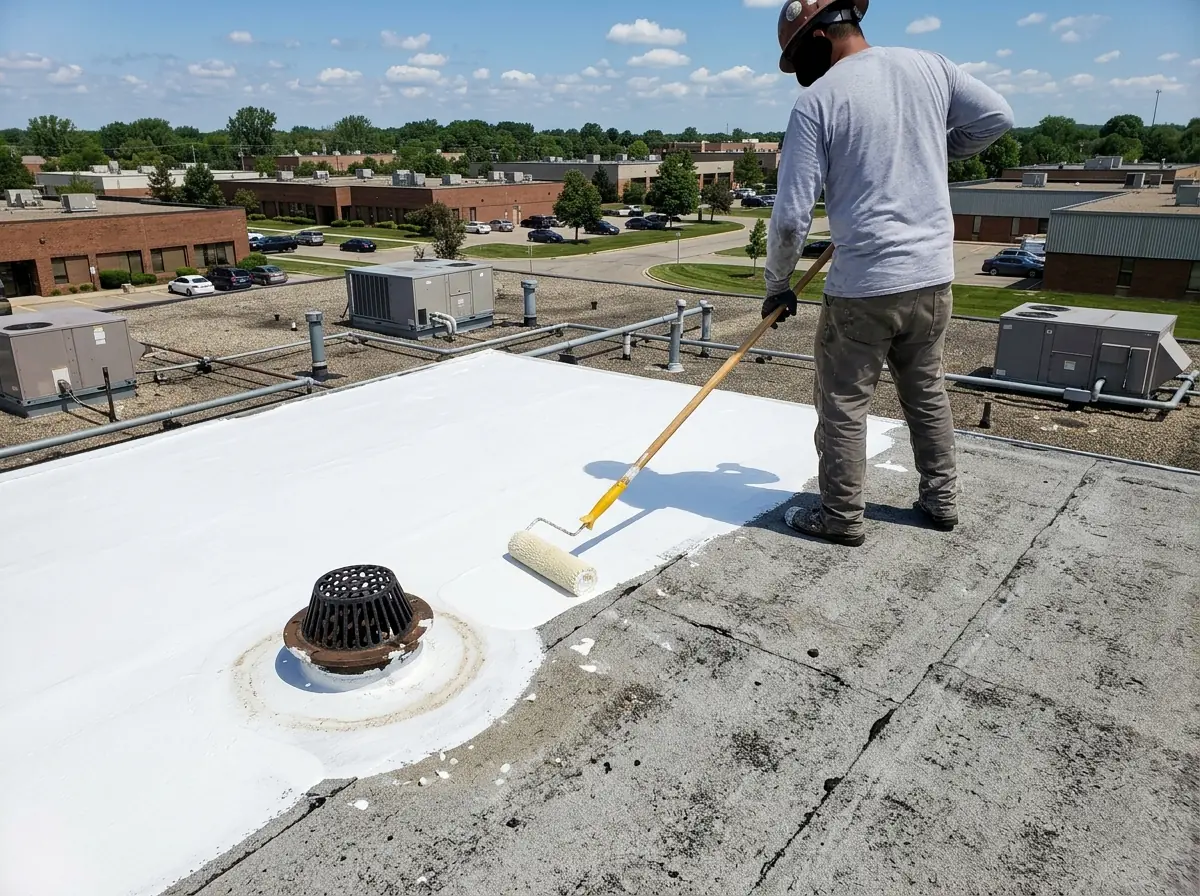
Silicone coatings (ASTM D6694) are moisture-cured, and their selling point is water. FacilitiesNet's overview credits silicone's rise on commercial roofs to how it holds up under long-term ponding, plus its UV resistance and its resistance to turning hard and brittle. GAF's Unisil data sheet, as one example, lists metal, TPO, PVC, EPDM, asphalt roofs, concrete and spray foam as approved substrates, applied in at least two coats of no more than 1.5 gallons per 100 square feet each.
Silicone also holds dirt and loses reflectivity over time, HomeGuide adds that it gets slippery when wet, and very little besides more silicone will stick to it later. BASF wrote in 2020 that no water-based acrylic on the market would bond to silicone. In our view, choosing silicone means committing to it for the life of the roof.
Acrylic Roof Coatings
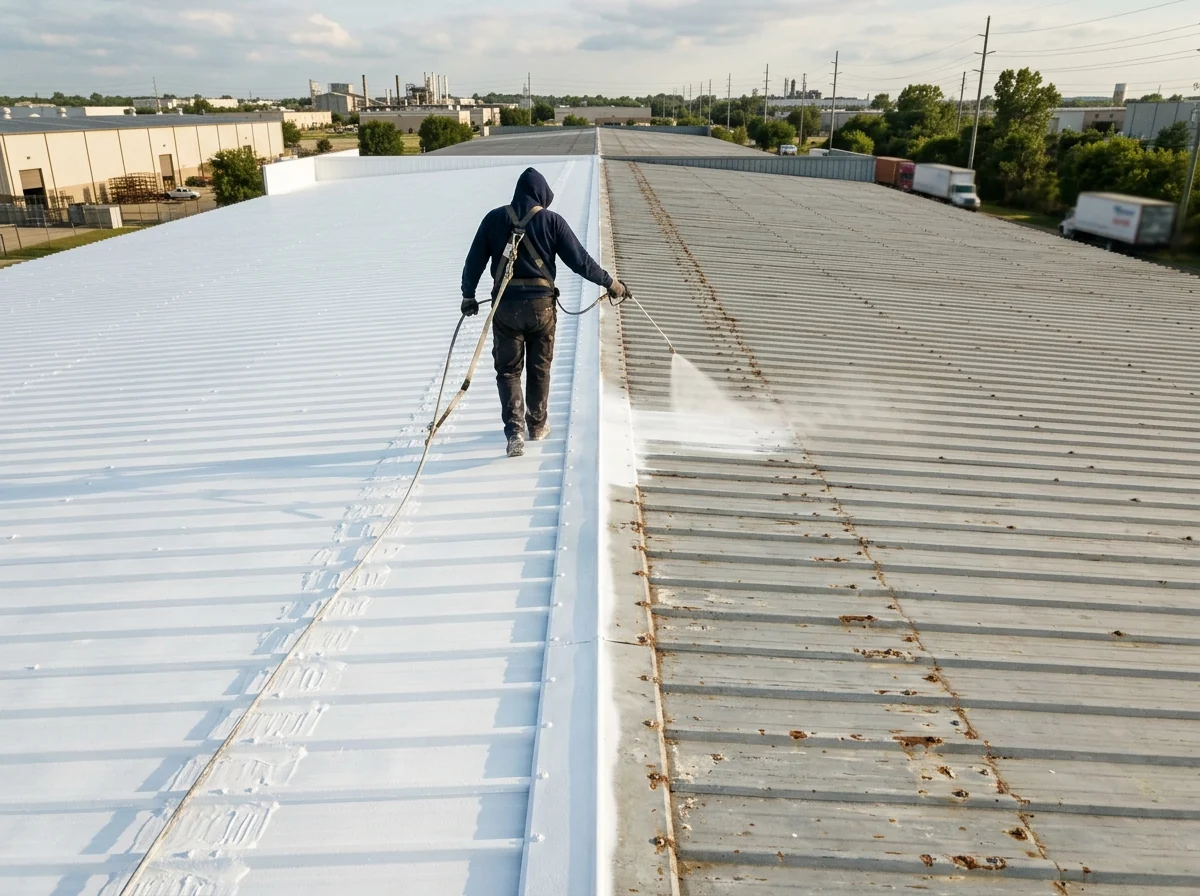
Acrylics (ASTM D6083) were first developed to protect spray foam from UV light and are now used on single-ply and metal roofs as well. FacilitiesNet calls them economical, highly reflective and easy to work with, but notes that they lose thickness as they weather, can't take ponding water and need warm, dry weather to cure. Conklin's Rapid Roof III data sheet shows a typical specification: a base coat and a top coat at 1.9 gallons per 100 square feet each, at least 13.5 dry mils per coat.
Our view: acrylic suits a sloped metal roof or a well-drained membrane, and it's a poor match for a flat roof where water sits in low spots for days after rain.
Polyurethane Roof Coatings
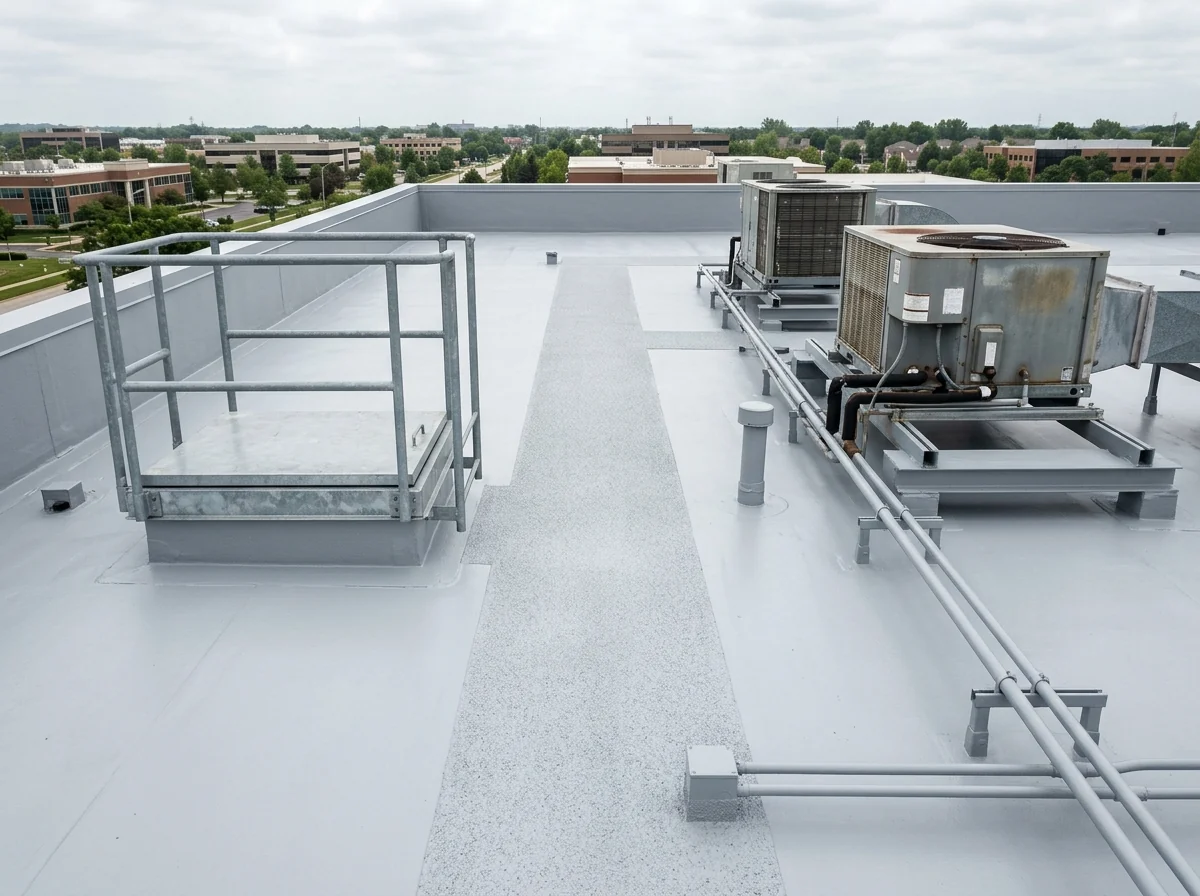
Moisture-cured polyurethane (ASTM D6947) is the tough one. FacilitiesNet rates polyurethane highest of the coatings for impact resistance and foot traffic, and describes the usual system as an aromatic urethane base coat under an aliphatic topcoat, which is UV-stable, stays cleaner and holds its color longer. HomeGuide's installed range is $1.50 to $4.00 per square foot, and it rates urethane ahead of acrylic on ponding. Price it for roofs that see regular HVAC service traffic.
Asphalt and Aluminum Roof Coatings
The code's coating table includes asphalt coatings (ASTM D2823 and D4479), aluminum-pigmented asphalt (D2824) and asphalt emulsion (D1227), the traditional family for built-up and modified bitumen roofs. FacilitiesNet also describes cold-process asphaltic rubber systems that build a seamless membrane from 20 to 200 dry mils thick. These are waterproofing coats first; ask for the product's CRRC rating if reflectance matters to you.
Why Troy building owners call Troy Commercial Roofing
- Free, no-obligation roof assessment and estimate
- Written scope and price before any work starts
- One local commercial roofing contractor per request, not a call list
- No charge to building owners for the referral
Cool Roof Coatings: Reading Reflectance Ratings
A cool roof is measured by two numbers, DOE explains: solar reflectance (how much sunlight bounces off) and thermal emittance (how readily the surface sheds the heat it does absorb), each scored from 0 to 1. The Cool Roof Rating Council rates roofing products on both, then sends samples to outdoor test farms for three years so buyers can see aged values next to the new ones. EPA's ENERGY STAR roofing label, still printed on some data sheets, ended on June 1, 2022, according to the CRRC.
The aged number is the one to use. GAF's silicone data sheet, for example, lists CRRC values for its smooth white coating of 0.83 solar reflectance new and 0.72 aged. A 2009 article in NRCA's Professional Roofing puts the typical pattern more bluntly: most coatings start at 0.85 to 0.90, drop to 0.70 to 0.75 within months as dirt settles, and level off around 0.60 to 0.70 after the first year. A Lawrence Berkeley National Laboratory study of weathered light-colored single-ply membranes found that washing with detergent brought most samples back to within 90% of their original reflectance, so cleaning is part of keeping the benefit.
What the code asks in Troy. The model 2021 energy code requires minimum roof reflectance only in climate zones 0 through 3. Oakland County sits in zone 5A, so a coating's color is the owner's choice here, not a code requirement.
Whether white pays off. DOE estimates a white roof can save a commercial building up to $0.20 per square foot a year, mostly in hot climates, and warns of some added heating demand in winter. NRCA's article reports an LBNL simulation in which cooling savings beat the heating penalty in every state, and points out that a dark roof under snow is white anyway. In Troy, reflectance is a summer bonus on a coating chosen for other reasons.
Roof Coating Thickness, Coverage and Warranty
RCMA explains the difference from paint in gallons: paint goes on at a fraction of a gallon per 100 square feet, coatings at several. That thickness is what a coating warranty buys. Progressive Materials, a silicone maker, ties its warranty terms to dry film thickness: on TPO, PVC and EPDM, 20 dry mils for 5 years plus 5 mils for each additional 5 years, or 35 mils for 20 years. Metal starts at 15 mils, and textured asphalt roofs need more.
Ask the bidder to write down:
- the product, its ASTM standard and its CRRC aged values;
- gallons per 100 square feet for each coat, and the target dry mils;
- how wet-film readings will be taken and recorded during application;
- the primer, if any, and the results of an adhesion test (commercial roof restoration describes one);
- the moisture survey that shows the roof is dry enough to coat (roof leak detection).
HomeGuide estimates that coating a weathered roof extends its life by 7 to 10 years. Whether coating or replacement makes more sense for a given roof is weighed on the restoration page.
Roof Coating Season in Michigan
Coatings cure, and cure depends on weather. GAF's silicone data sheet sets a 40°F minimum air temperature and says not to apply with rain, dew, fog or freezing in the 2-hour forecast. Conklin's acrylic also sets 40°F, plus a surface at least 5°F above the dew point and humidity under 80%, while FacilitiesNet's overview gives 50°F as the floor for acrylics generally. In cold weather Elevate stores its coatings between 60°F and 80°F until they go on the roof.
Detroit's normal daily high is 45.9°F in March and 37.2°F in December, and May is the wettest month on the record. By our reading of those normals, acrylic work fits best between late spring and early fall, while a silicone rated to 40°F, put down on a dry day, gives a little more room at either end. Ask the bidder what forecast it will start on and what happens if rain arrives before the coat cures.
Call with the roof's size, what it's made of and whether water stands on it after rain. We pass that to one local roofer, at no cost to you, who can say which coating fits.