
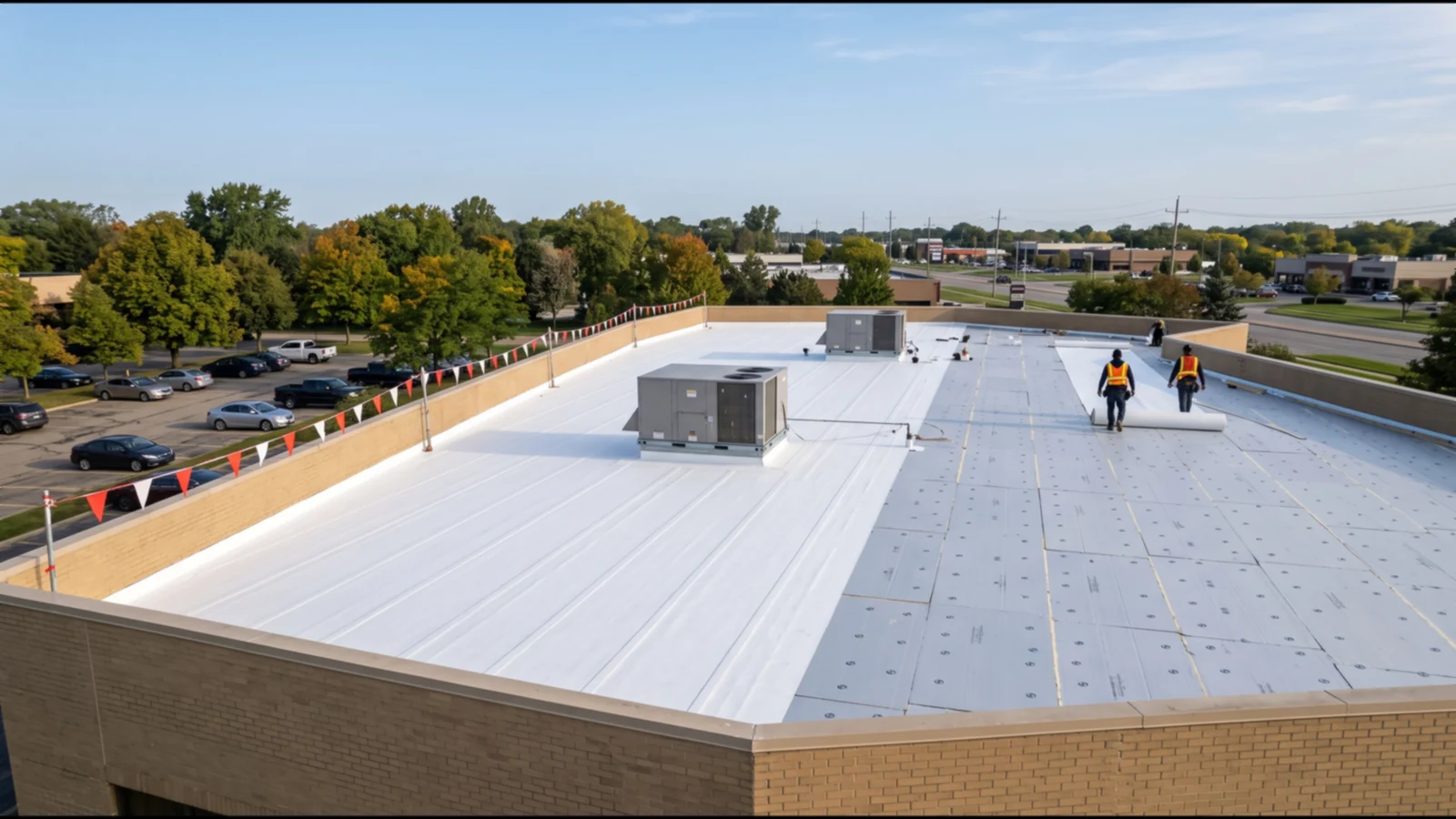
EPDM Roofing Systems for Troy Buildings
ASTM D4637 sorts EPDM sheet into three builds: non-reinforced (Type I), scrim-reinforced (Type II) and fabric-backed (Type III). The standard covers the rubber only. Fire rating, seam strength and wind uplift belong to the finished system, which is why the way the sheet is attached matters as much as the sheet.
Fully Adhered EPDM
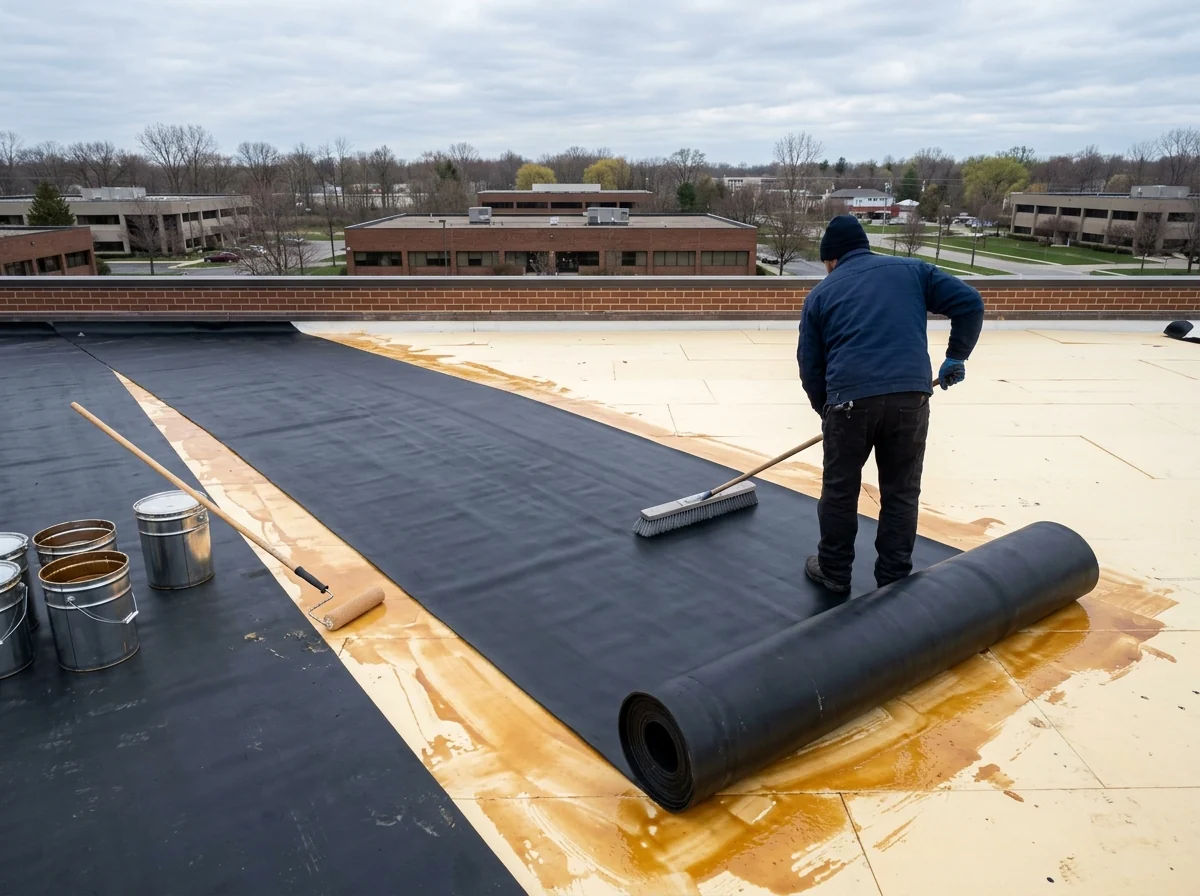
Bonding adhesive goes on both the substrate and the underside of the rubber, the sheet is rolled into place, then broomed down. Carlisle's non-reinforced Sure-Seal sheet in 45, 60 and 90 mil is used mainly this way, in panels up to 10 feet wide and 100 feet long; Johns Manville's selector lists non-reinforced rolls up to 40 by 100 feet. Big panels mean fewer field seams.
Solvent-based adhesive has to flash off before the rubber goes down. MuleHide warns that skipping that wait blisters the membrane, and it wants the adhesive between 60°F and 80°F before it is spread. On a cool morning that means warm storage and patience, and both belong in the schedule.
Mechanically Fastened EPDM
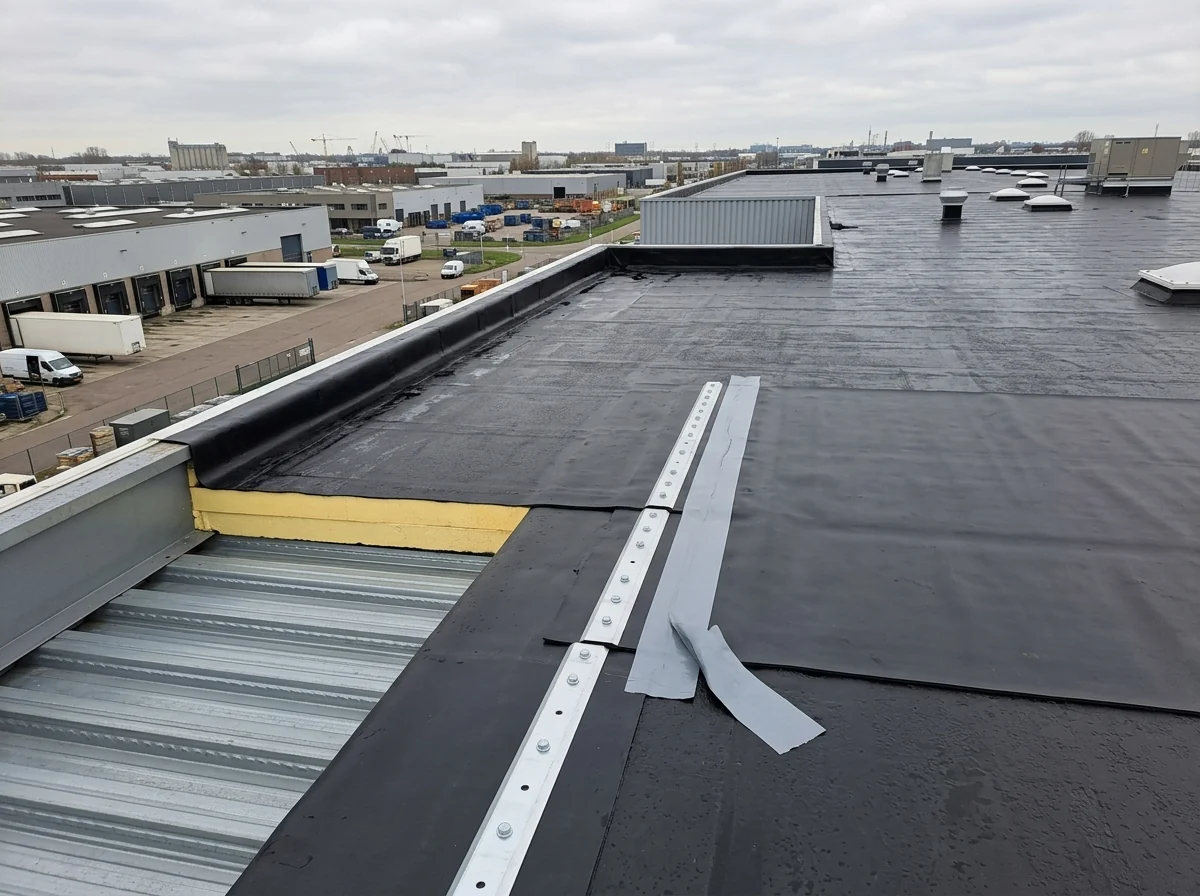
Fastening a rubber sheet through its laps needs reinforced EPDM. Johns Manville lists its non-reinforced sheet for ballasted and fully adhered roofs only, while reinforced sheet with a polyester mat can also be fastened. Carlisle's Sure-Tough reinforced line comes in 45, 60 and 75 mil, in 10-by-100-foot rolls, with 5- and 6.5-foot widths for perimeter sheets and higher uplift ratings. Carlisle claims 60% more puncture resistance than its non-reinforced sheet.
Plates or bars hold the seams, and the insulation is screwed to the deck. Carlisle's own data sheet notes that sheet flutter and noise may occur on mechanically fastened systems. Over a warehouse nobody hears it. Over top-floor offices, we'd lean toward an adhered or fleece-back design. Reinforced EPDM is also one of the routes for retrofitting old metal roofs; see commercial roof replacement.
Ballasted EPDM
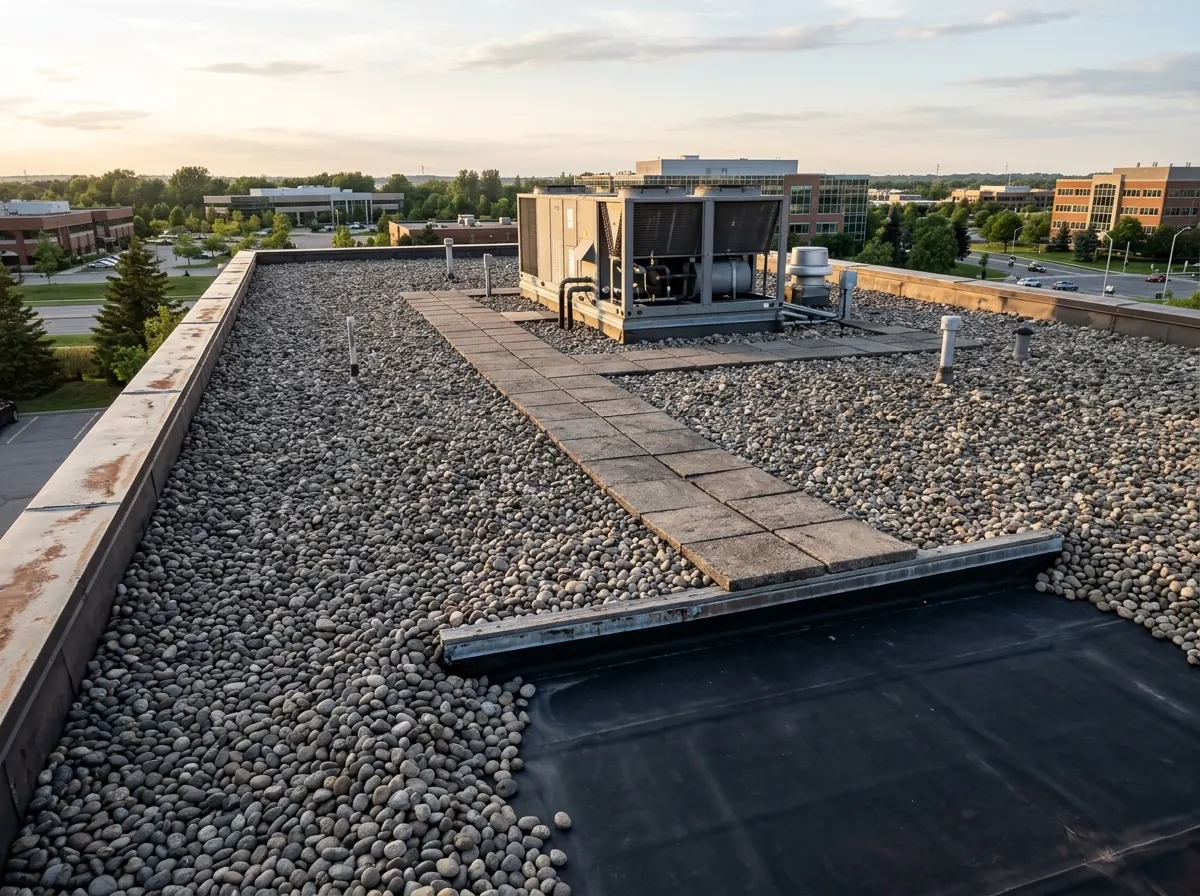
A ballasted roof is loose-laid: rubber over rigid insulation, sealed at the seams and secured at the perimeter and penetrations, held down by its own weight in stone. Carlisle calls loose-laid EPDM over rigid board the most common ballasted assembly. Its stone is at least an inch across, applied at 10 pounds per square foot (the code minimum) up to 25 pounds or more. Concrete pavers can replace stone where people walk.
The advantages are speed, fewer adhesives and easy repairs: Carlisle notes the layers lift without fighting glue, and the stone goes back on. The disadvantages are the weight, which the structure has to carry, and wind at the corners. The code ties low-slope ballasted designs to the RP-4 wind standard mentioned on our homepage, so ask what stone size and weight the design calls for at corners and edges.
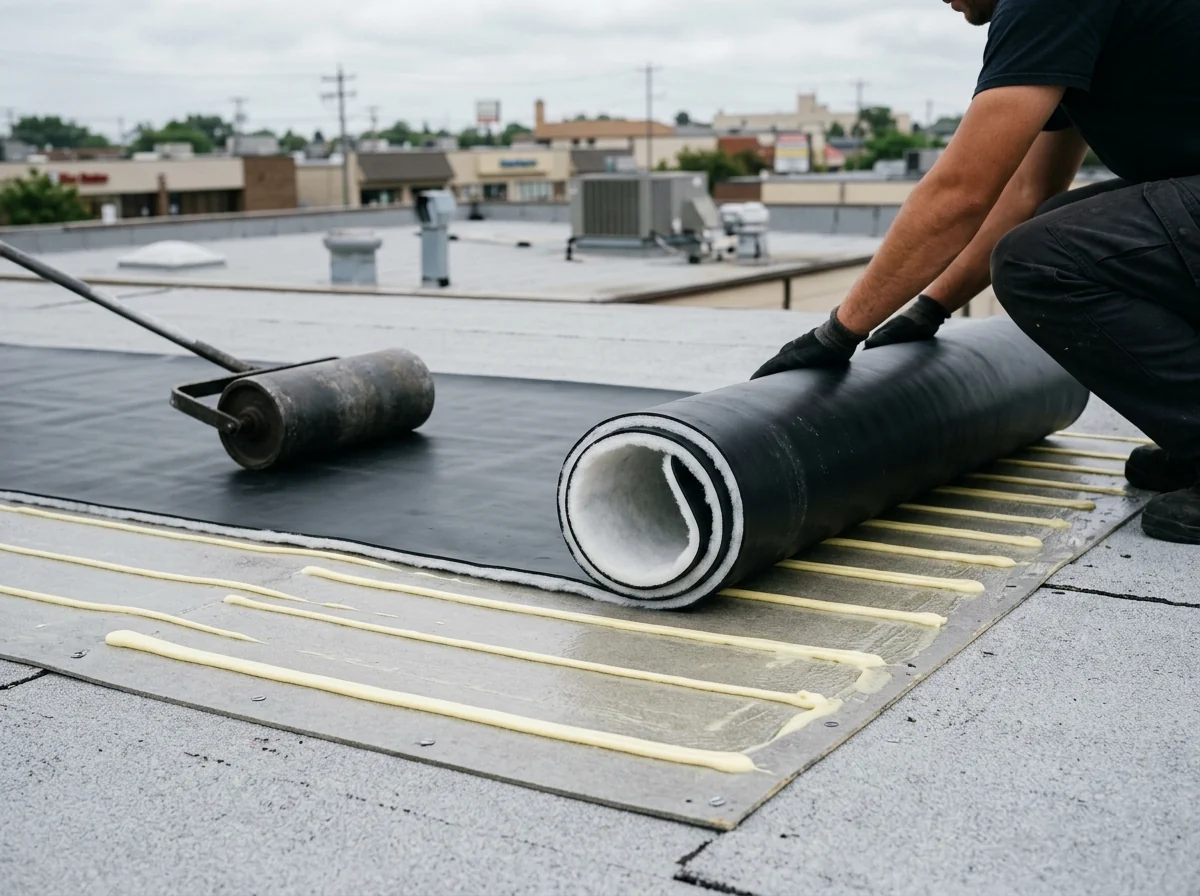
Fleece-Back EPDM
A fleece mat bonded to the underside lets the sheet be set in low-rise polyurethane foam adhesive instead of solvent cement. Carlisle's FleeceBACK EPDM comes in total thicknesses of 100, 115 and 145 mil with factory-applied tape, and its two-part foam adhesive is VOC-free, quiet and low-odor, which Carlisle pitches for re-roofing occupied buildings. The maker also claims the fleece adds 40% puncture resistance and 180% tear resistance over standard sheet. Its 30-year system warranty needs the 145-mil black sheet.
EPDM Roof Repair
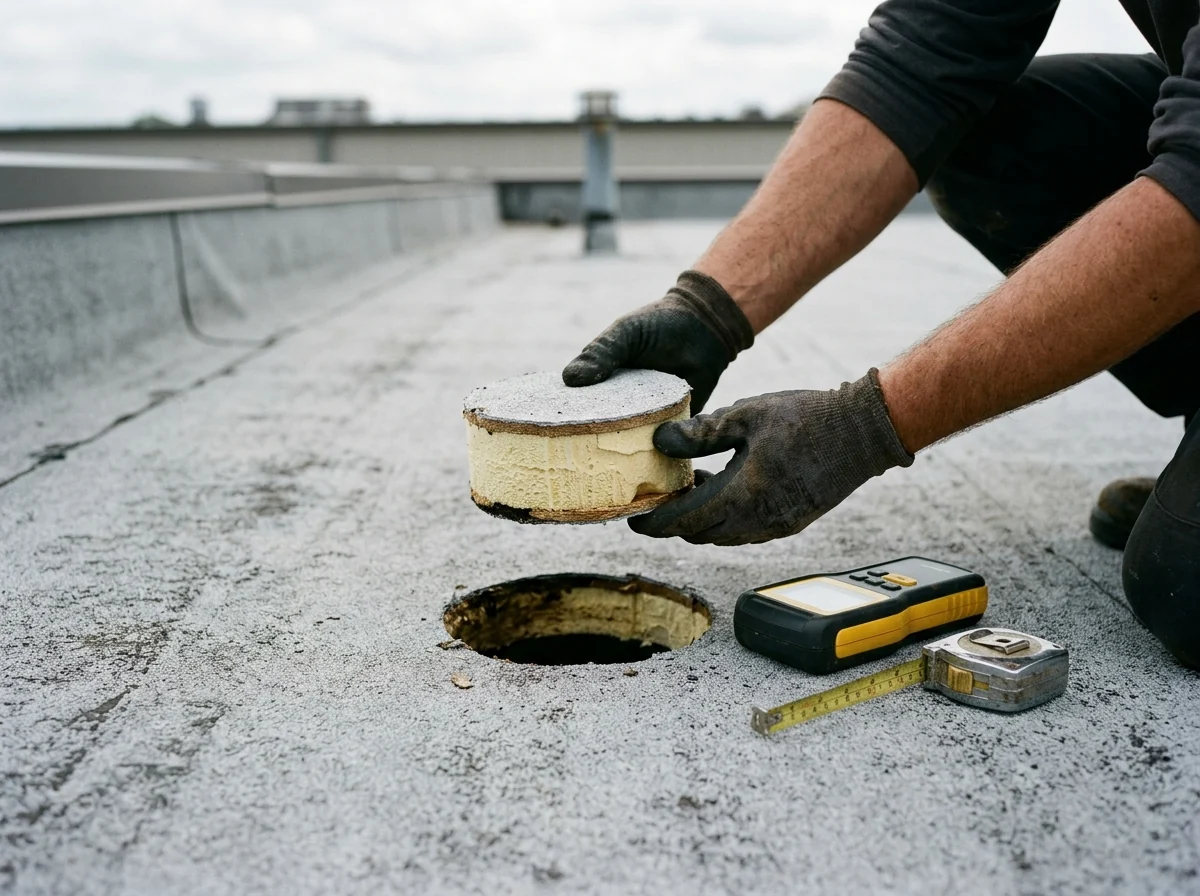
Most EPDM repairs are seam repairs, and the cause is often talc left on the laps at installation, according to a Roofing Contractor technical column. In-service rubber is scrubbed with a weathered-membrane cleaner before any primer or tape will hold, per Carlisle's product sheet. Patching and leak tracing are covered step by step on commercial roof repair.
Why Troy building owners call Troy Commercial Roofing
- Free, no-obligation roof assessment and estimate
- Written scope and price before any work starts
- One local commercial roofing contractor per request, not a call list
- No charge to building owners for the referral
EPDM Seams and Flashings: Where the Roof Succeeds or Fails
An EPDM seam is a chemical joint. The lap is cleaned, primed and closed with splice tape, either hand-applied on the roof or applied at the factory. Carlisle argues factory tape moves most of the seaming work into a controlled plant, and Johns Manville offers inseam tape 4 or 6 inches wide. Our view: fewer field-made seams is a fair thing to pay a little more for, since field seams are where the trouble starts.
Cold changes the procedure. Below 40°F, Carlisle's instructions call for heating the primed bottom sheet with a hot-air gun as the taped top sheet is pressed down, then heating the top of the lap again before rolling it with a 2-inch steel roller. Uncured EPDM flashing around curbs and pipes can also need a heat gun to form in winter, Elevate and MuleHide both note. If a job runs past October, ask the contractor to describe the cold-weather seaming steps it will follow.
EPDM Roofing Cost and Life Expectancy
HomeGuide's installed range for EPDM appears on our homepage. Broken down, HomeGuide puts the membrane at $0.50 to $2.50 per square foot and flat roof labor at $2.00 to $4.50, and it gives EPDM a 15 to 25 year lifespan. In our view the low end of that range goes to thin sheet, field-made seams and neglected drains.
Thickness is tied to warranty length. Carlisle uses 90-mil sheet for its 30-year EPDM system, available with hail, puncture and wind coverage up to 120 mph, and Elevate's 30-year Platinum term likewise needs fully adhered EPDM of at least 90 mil. Warranty types are explained on commercial roof replacement. Other price movers: tear-off versus recover, the insulation the energy code asks for on a replacement (commercial roof insulation), crane time and the number of curbs to flash.
EPDM Roofing in Troy Weather
Cold. Carlisle says its sheet stays flexible down to -40°F. Detroit's normal January low is 19.2°F, so the cured rubber is nowhere near its limit, and HomeGuide counts EPDM among the membranes that do well in cold climates.
The install calendar. Adhesives set the limits. Elevate moves to cold-weather procedures below 40°F, keeps adhesives in 60°F to 80°F storage until use, and allows its solvent-free EPDM bonding adhesive only above 40°F, with no freeze expected for 12 hours afterward. Self-adhered EPDM goes colder: Elevate allows its version above 20°F, and MuleHide sets 20°F for black self-adhering sheet and 32°F for white. Carlisle says ballasted roofs can be installed across a wide range of temperatures. A winter EPDM start is possible, but the system choice narrows.
Hail. Carlisle credits the rubber's stretch (465% elongation on its data sheet) for the UL 2218 Class 4 rating on its Sure-Seal sheet, and says the fleece-back system passes FM's severe hail test. Hail thresholds and local storm reports are on storm damage roof repair.
Black or white. Carlisle argues that dark EPDM is the smart choice in cold climates, where it says heating costs generally run 3 to 5 times cooling costs (a manufacturer's claim). DOE agrees that cool-roof savings are largest in hot climates and that a reflective roof can add heating demand. White EPDM is available for buildings with heavy cooling loads; reflectance ratings are explained on commercial roof coatings.
What to Put in an EPDM Roofing Bid
Sheet build and thickness
Non-reinforced, reinforced or fleece-back, and how many mils.- Attachment method, and for a ballasted roof the stone size, the weight per square foot and who checked the structure.
Seams
How much is factory tape and how much is taped in the field, and the cold-weather procedure if the work runs late in the year.- Adhesive type (solvent-based, solvent-free or foam) and the maker's temperature limits.
- Which manufacturer warranty, for how many years, with any hail or wind coverage written in.
- Proof the contractor can pull a Troy building permit; the city's registration rules are on the replacement page.
Tell us the roof size and what's on it now. We pass that to one independent roofer who works with EPDM, and the referral costs you nothing.