
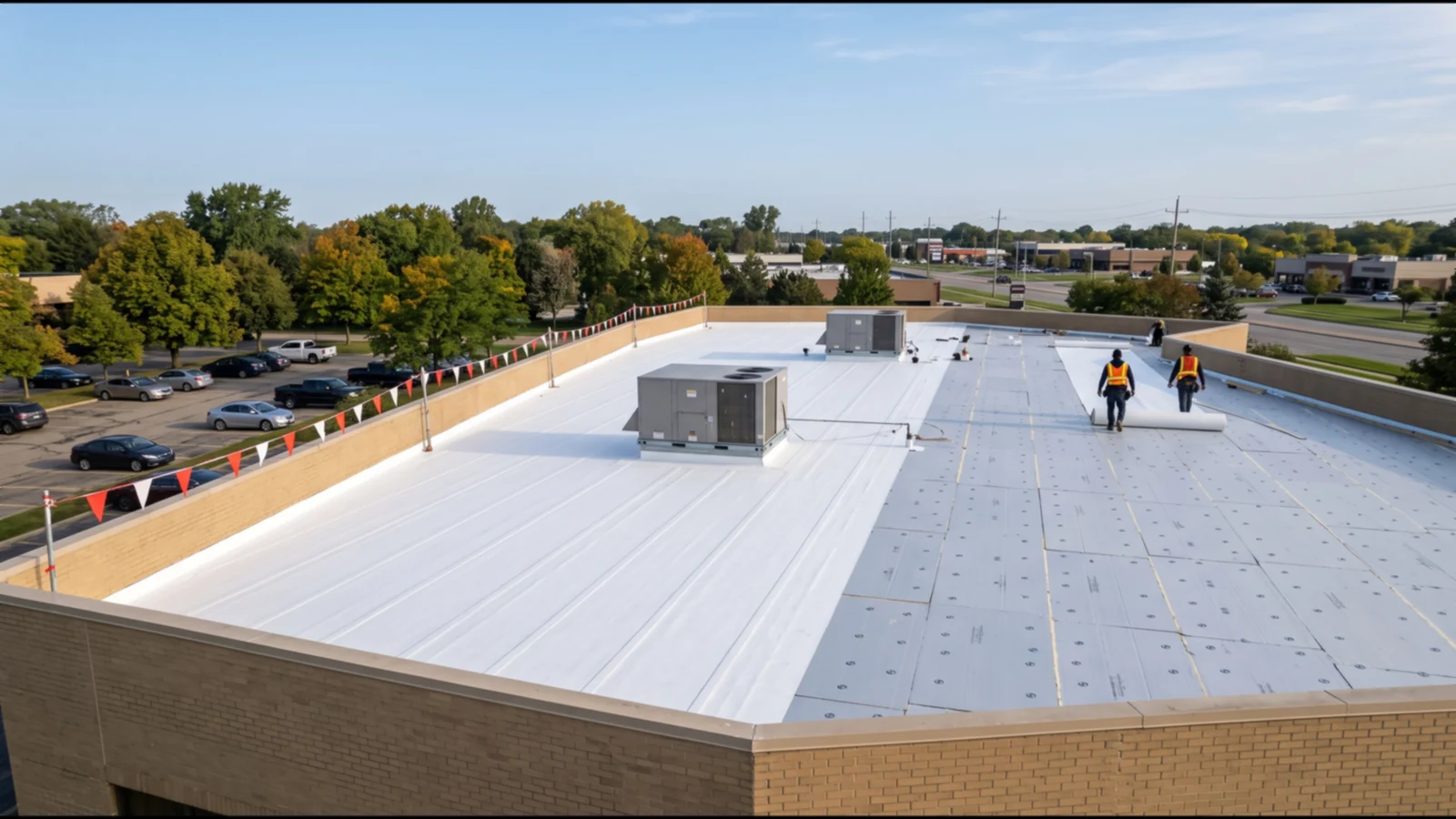
Emergency Commercial Roof Repair Types for Troy Buildings
An emergency visit has one goal: stop the water now without making the permanent repair harder or putting the warranty at risk. Most calls fall into one of five situations.
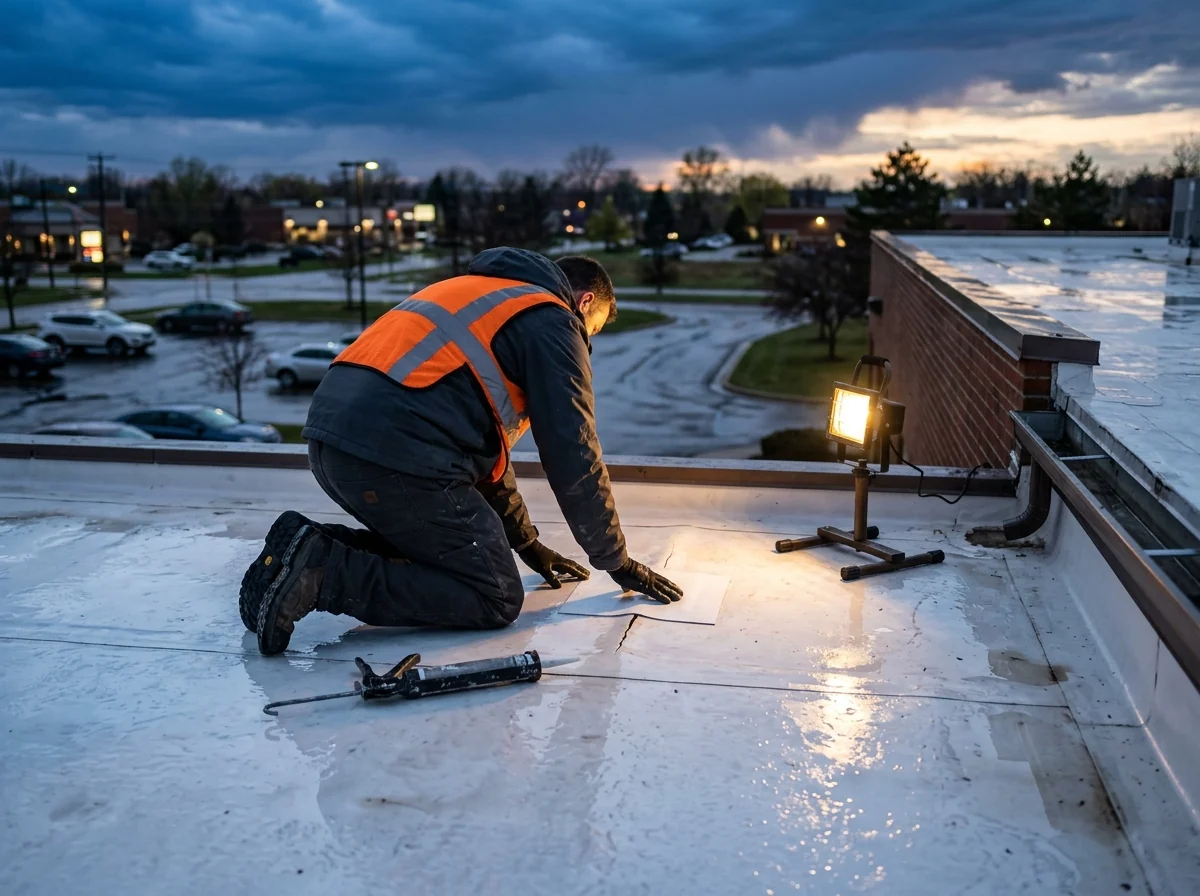
Temporary Membrane Patches and Sealed Seams
On a single-ply roof, the bucket of black roof cement is the wrong tool. Carlisle's owner's manual says a minor emergency repair to a suspected leak on its membranes should use lap sealant or a good-grade rubber caulk, not asphaltic roof cement, and that the owner should contact the manufacturer once the leak is confirmed to come through the roof system.
Asphalt products belong on built-up and modified bitumen roofs. One wet-patch roof cement's product sheet lists wet-surface adhesion under ASTM D3409, the ASTM D4586 roof cement specification, and application from 20°F to 120°F, even in standing water. On an asphalt roof in the rain, that's useful. On TPO, PVC or EPDM, in our view, it's just residue that has to come off before anything will bond. Ask what went on and where, so whoever does the permanent repair knows what they're dealing with.
Emergency Tarps and Temporary Covers
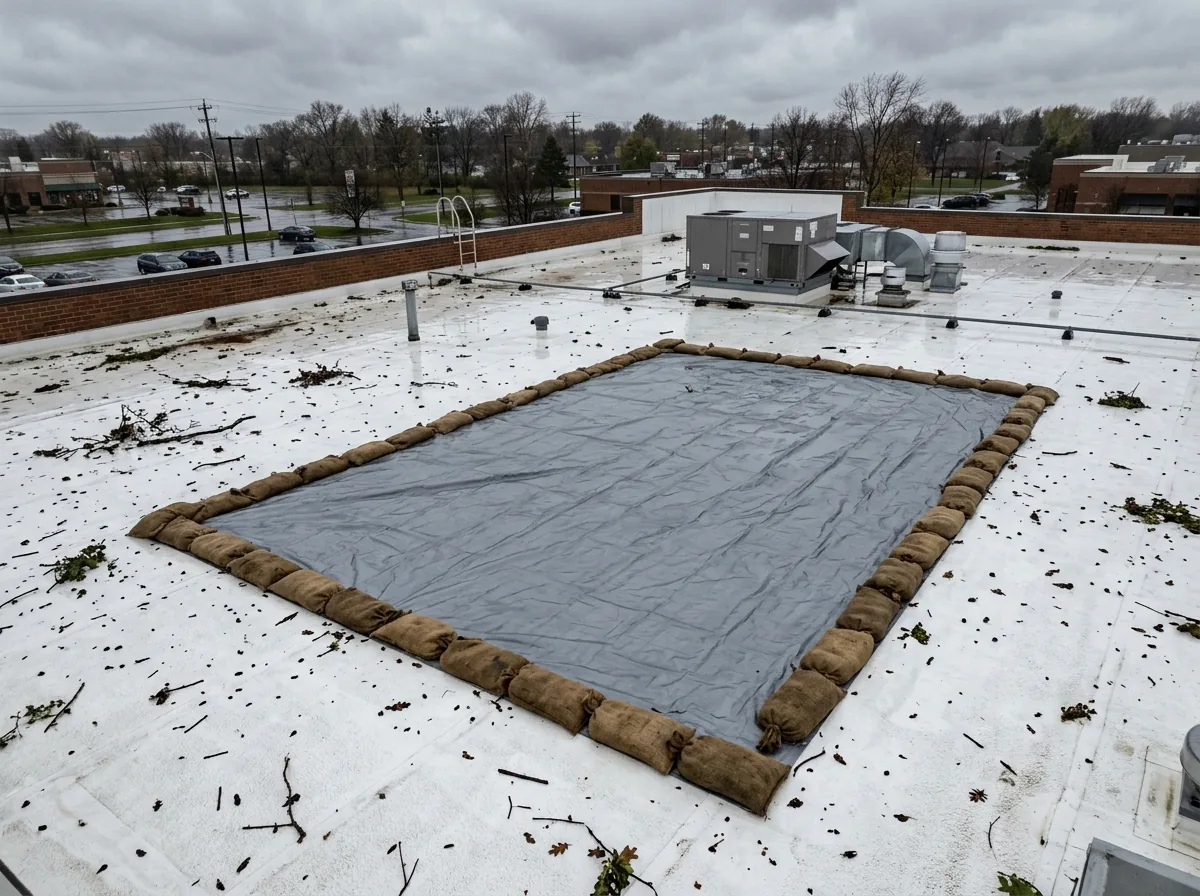
When the opening is too big to patch, such as a section torn open by wind or a skylight broken by hail, a cover goes over it. HomeGuide puts roof tarping at $0.70 to $2.00 per square foot installed and $1.00 to $2.80 for after-hours emergency service, with a $100 to $200 call-out fee possible outside business hours. Its figures come mostly from one-story homes, so a large roof can land outside them.
On a flat roof, how the cover is held down matters. HomeGuide lists plywood, screws or sandbags as anchoring materials, and every screw through a membrane is a new hole. Ask how the cover will be weighted and whether anything will go through the sheet.
Peeled Membrane and Blown-Off Edge Metal
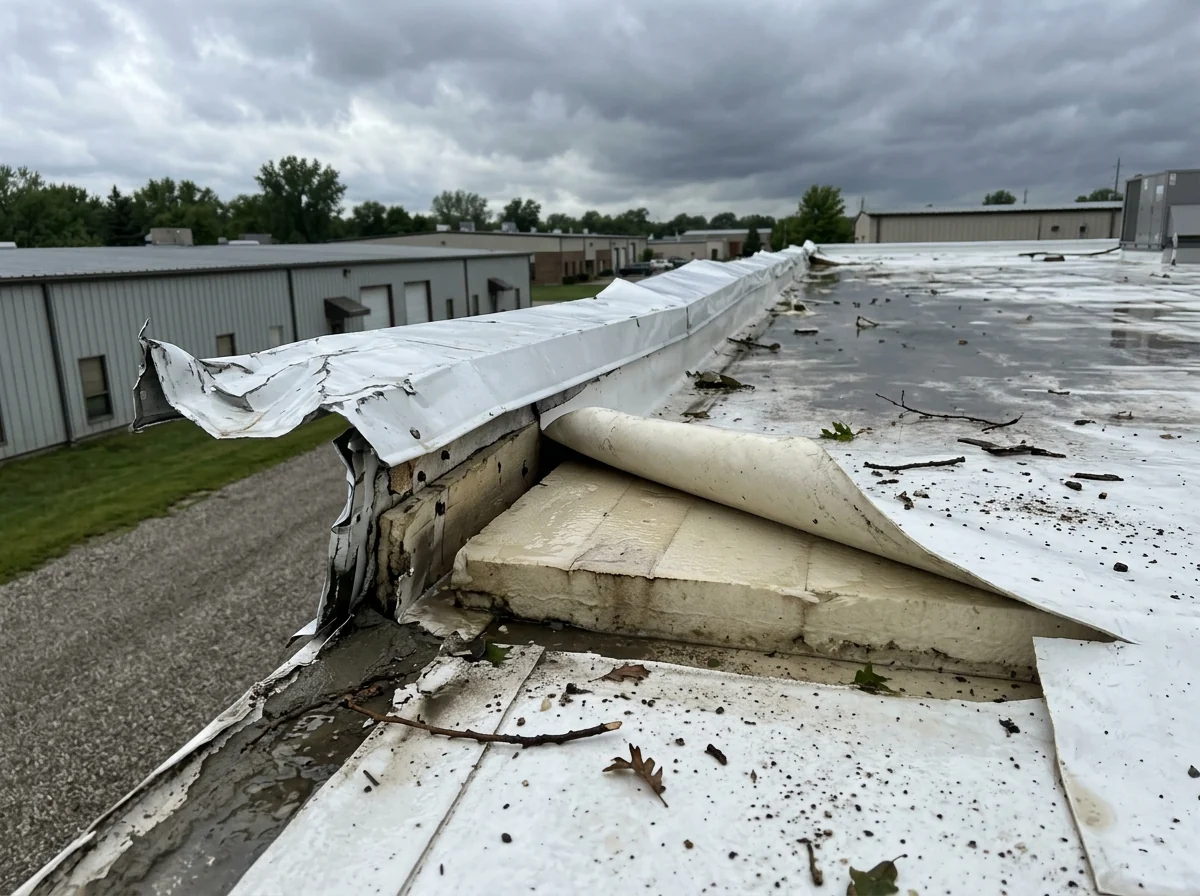
FEMA's guidance for public buildings says low-slope membrane roofs often fail at the edges in high winds, when metal edge flashing, copings or fascia covers lift and peel. A gutter lifted by wind can drag the edge flashing up with it and start a progressive peel of the membrane. Once air is under the sheet, every gust opens more of it. The emergency fix is to stop the peel: refasten or weigh down the loose edge, cover exposed insulation and keep the sheet from flapping. Rebuilding the edge properly is storm work, covered on storm damage roof repair.
Rooftop Unit and Penetration Leaks
The same FEMA guidance warns that wind can blow access panels off rooftop HVAC units and turn them into debris that tears membranes, and that poorly anchored equipment knocked out of place tears and peels the roof as it skips across it. After a windstorm, a leak near a unit often has an obvious cause: a missing panel, a shifted curb, a gash in the sheet. The temporary seal goes around the damage. The unit itself is a job for the mechanical contractor.
Overflowing Drains and Ponded Water
Water pouring in at a drain or down an inside wall often means a blocked drain rather than a hole. FM Global's hail data sheet notes that hail often blocks roof drains and gutters, and leaves and ice do the same thing. Clearing a strainer can be the whole emergency job. If water is still standing days later, that's a drainage problem; roof drain repair explains what counts as ponding. Heavy snow on the roof is its own kind of emergency, covered on roof snow removal.
Why Troy building owners call Troy Commercial Roofing
- Free, no-obligation roof assessment and estimate
- Written scope and price before any work starts
- One local commercial roofing contractor per request, not a call list
- No charge to building owners for the referral
Emergency Roof Leak Repair: What to Do Inside First
Nobody should be on the roof during a thunderstorm, the roofer included. The National Weather Service says no place outside is safe during thunderstorms and tells workers to stay off rooftops, scaffolding and ladders, and its outdoor guidance is to wait 30 minutes after the last thunder before going back out. A good roofer will wait out the lightning. Until then, the building is yours to manage.
- 1
Watch the ceiling and the deck
FEMA lists sagging ceiling tiles, sprinkler heads dropping below the ceiling, sagging metal deck, popping or cracking sounds and severe leaks among the signs of an overstressed roof structure. If they appear, it says to evacuate and have a professional engineer inspect. - 2
Photograph before you move anything
Wide shots first, then close-ups, with the time showing. The full list an insurer will want is on storm damage roof repair. - 3
Catch the water
Buckets, plastic sheeting over equipment and files, and soaked ceiling tiles taken down before they fall on someone. - 4
Start drying
OSHA's guide to mold in the workplace says a prompt response, within 24 to 48 hours, of drying or removing water-damaged materials prevents or limits mold growth, and it names roof leaks as a source of building moisture. That clock runs on the carpet, drywall and ceiling tile below. Wet insulation inside the roof won't dry on its own; finding how far it runs is a job for roof leak detection. - 5
Hold permanent work if a claim is likely
Michigan's insurance regulator tells owners to protect the property but not to make permanent repairs until the insurer has inspected, and to keep receipts.
After-Hours Commercial Roof Repair: Night, Cold and Safety
Night work has rules of its own. OSHA's construction standard calls for at least 5 foot-candles of general lighting in construction areas while work is in progress, so expect portable work lights rather than headlamps alone. Fall protection on a low-slope roof still applies in the dark. The rules are summarized on commercial skylights and roof hatches, and an unguarded skylight is exactly the hazard nobody sees at night.
Cold limits what can be done. The adhesives used on fully adhered membranes are cold-weather sensitive, and from December through March, Detroit's normal lows sit below freezing. A January repair is often a dry-in that holds until spring. That's acceptable as long as everyone knows it's temporary.
Ask for a short written record of every emergency visit:
- what was found, marked on a roof plan or photo;
- what was done, and with which material;
- which repairs are temporary, and what the permanent repair should be;
- whether the roof has a manufacturer's warranty, and whether the manufacturer has been told.
That last line matters. Carlisle's manual says the manufacturer doesn't pay for emergency temporary repairs and asks owners to contact it once a leak is verified as coming through the roof. Other manufacturers have their own leak-report steps; commercial roof repair covers repairs on a warrantied roof.
Emergency Commercial Roof Repair Cost
Most published prices for emergency roof work come from houses. HomeGuide's tarp figures are among the few with an after-hours line, and that line runs about 40% above standard tarping at both ends of the range (our calculation). On a commercial building, the bill moves with access (roof hatch, ladder or lift), the size of the opening, the weather and how many people the work needs to be done safely at night. The permanent repair is priced separately; published repair ranges are on commercial roof repair.
Call or send the form with the address and what you're seeing, and we pass it to one independent local roofer. There's no charge for the referral.