
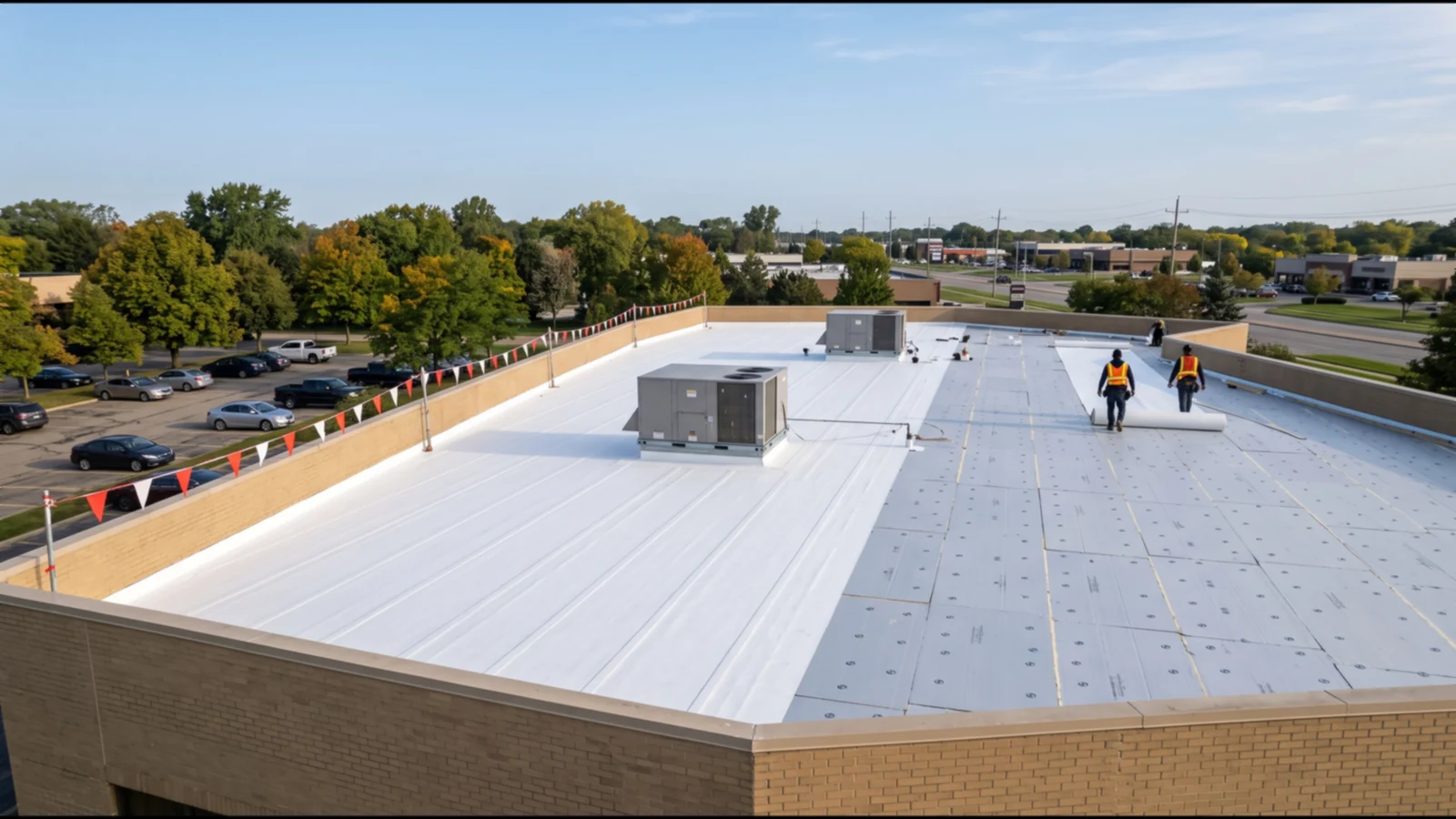
TPO Roofing Systems for Troy Buildings
TPO goes down in one of three ways, and each one suits a different deck, schedule and wind exposure.
Mechanically Attached TPO
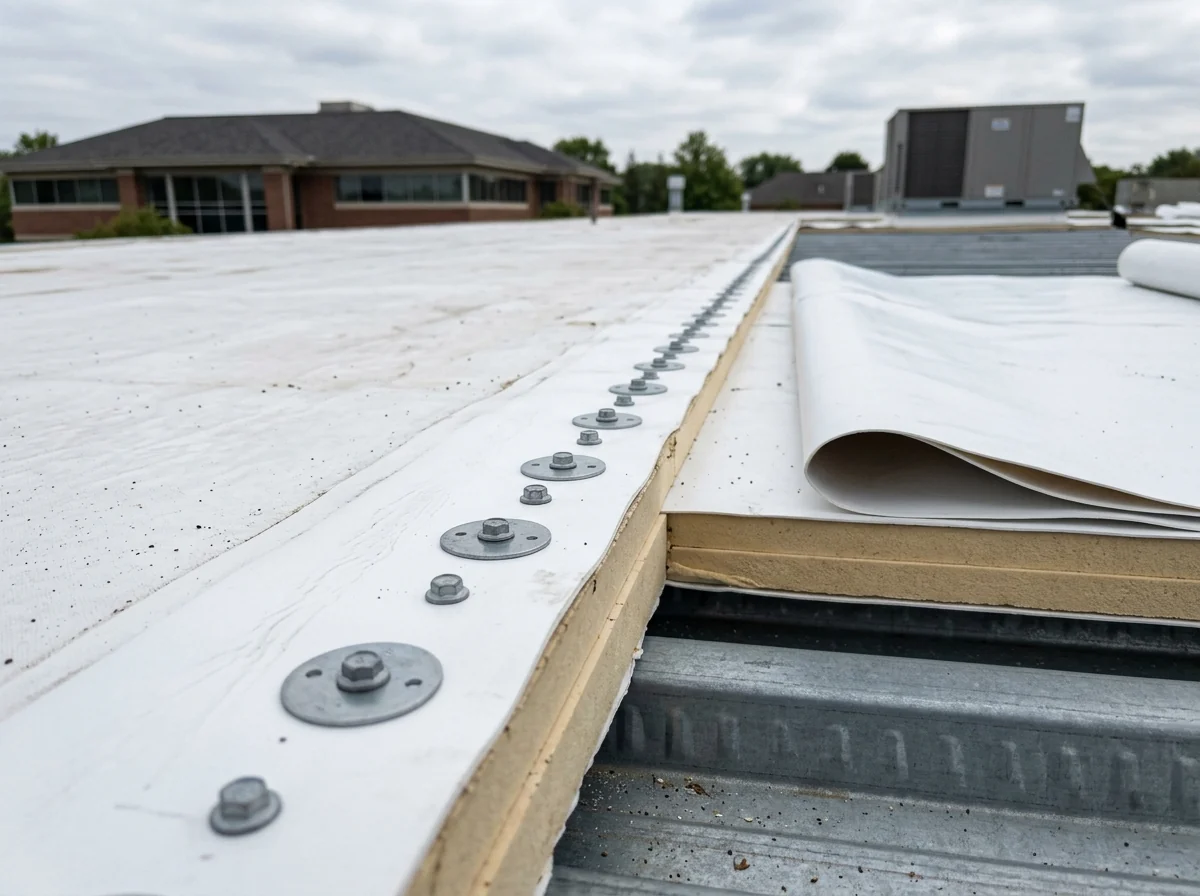
Screws and plates go through the edge of each sheet into the deck, and the next sheet laps over them and is welded shut. MuleHide describes this as generally the fastest and most economical attachment, especially on steel and wood decks, which covers most warehouses and many older office buildings. The insulation underneath is fastened only enough to hold it in place, because the seam fasteners do the holding.
The catch is at the edges. Corners and perimeters see the highest wind uplift, so most thermoplastic roofs need extra fastening there, typically with narrower perimeter half-sheets and more seams to weld. Ask the bidder to show the fastening pattern for the field, perimeter and corners.
Fully Adhered TPO
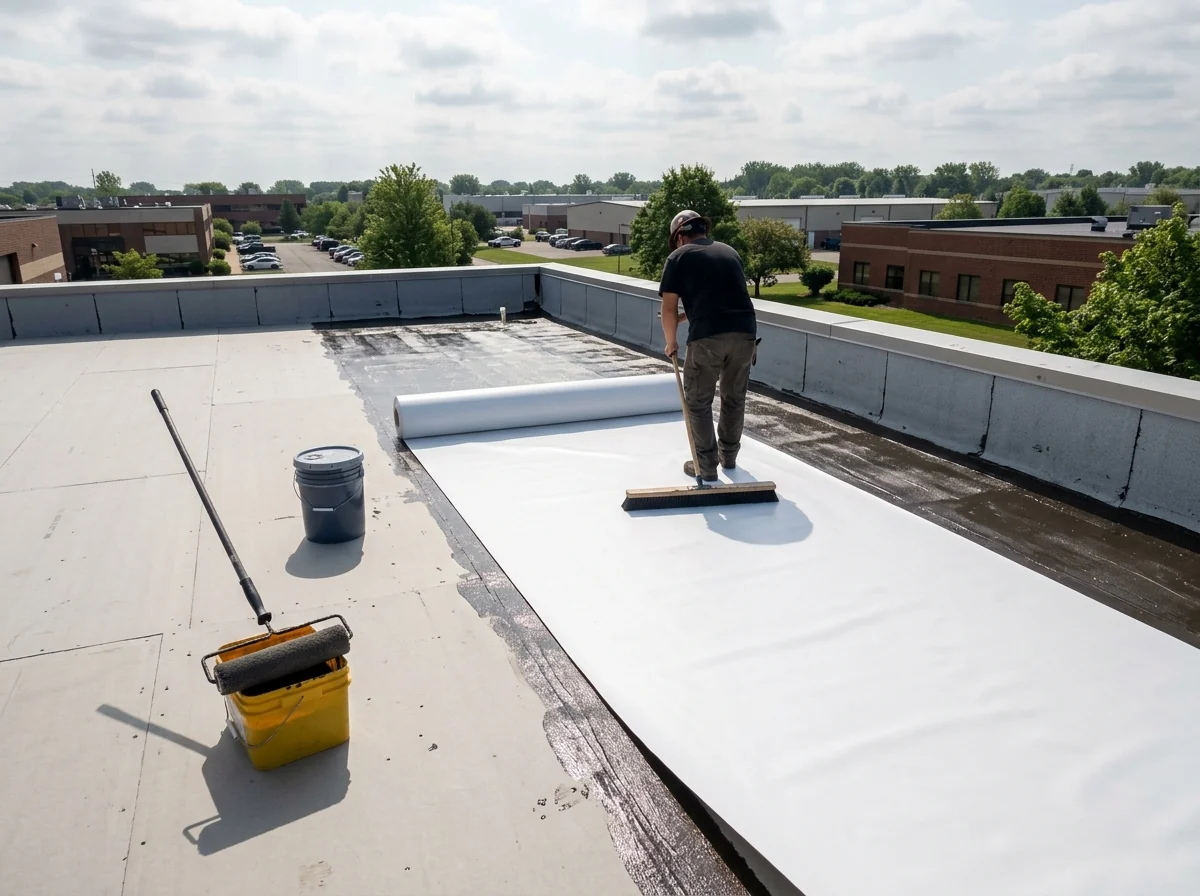
Here adhesive bonds the sheet to a cover board or insulation, so the whole membrane resists uplift rather than a line of plates. MuleHide says full adhesion can be the easiest and most economical choice on concrete and gypsum decks, where screwing down a membrane takes more labor and special fasteners. In our view it's also the kinder install for occupied offices, with no screw guns running over tenants' heads.
The trade-off is weather. Those adhesives are cold-weather sensitive, and in Southeast Michigan that narrows the season. A fully adhered TPO job priced for November should come with the adhesive maker's temperature limits and a plan for when the thermometer won't cooperate.
Induction-Welded TPO
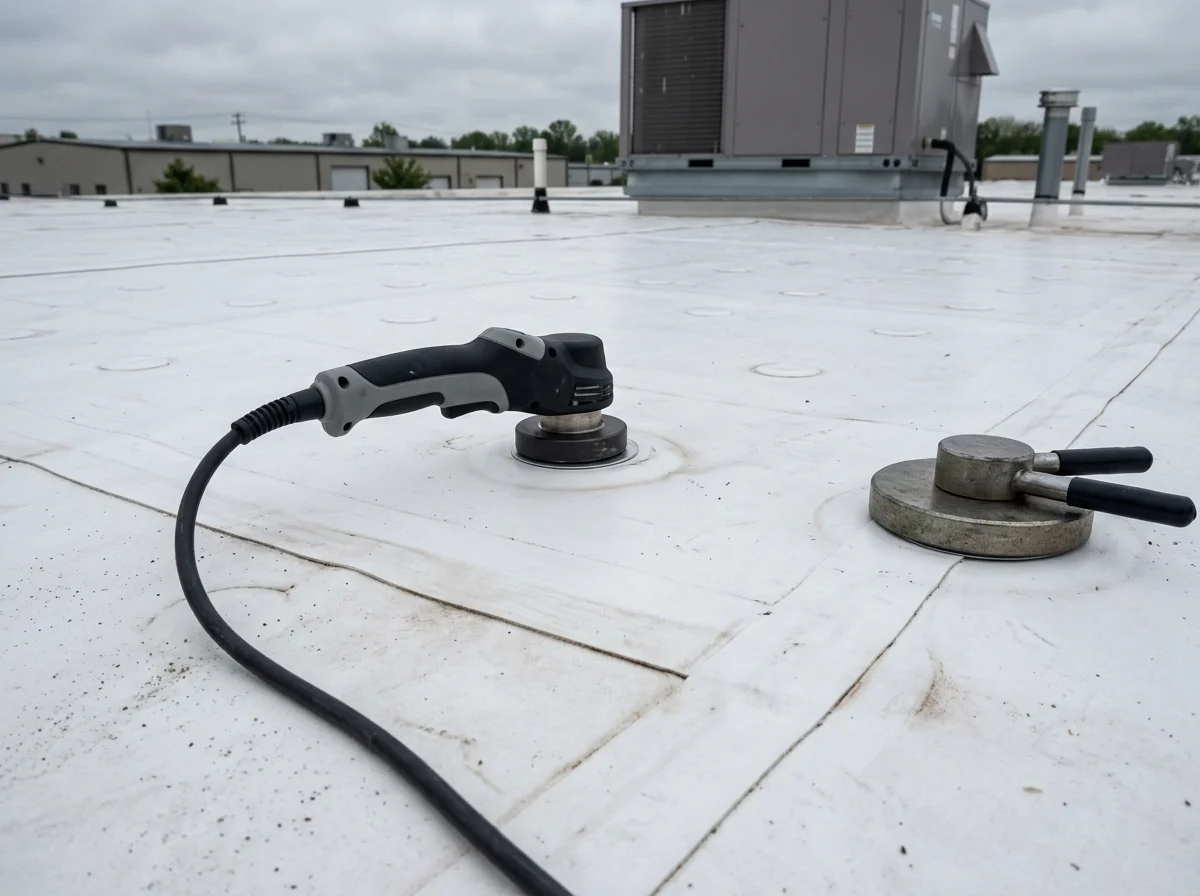
A newer variant of mechanical attachment. The plates that hold the insulation are installed first, the membrane is rolled over them, and an induction tool heats each plate so it bonds to the underside of the sheet. OMG, which makes the RhinoBond system, says the membrane is never penetrated, the system typically needs 25% to 50% fewer fasteners than in-seam attachment, and full-width sheets can run to the perimeter, cutting seams by up to 30%. Those are the maker's numbers, so ask the bidder for the wind uplift rating of the exact assembly.
TPO Roof Repair and Recover
TPO repairs are welded, which means the old sheet has to be clean enough to accept the weld. Aged, chalky TPO needs a cleaner made for weathered membrane before the welder touches it; the step-by-step is on commercial roof repair. An aging roof that is still dry can often take a TPO recover over a cover board instead of a tear-off; the code limits are on commercial roof replacement.
Why Troy building owners call Troy Commercial Roofing
- Free, no-obligation roof assessment and estimate
- Written scope and price before any work starts
- One local commercial roofing contractor per request, not a call list
- No charge to building owners for the referral
TPO Membrane Thickness: What the Extra Mils Buy
TPO is a sandwich: a polyester reinforcing scrim with TPO above and below it. The top layer is what sun and foot traffic wear down, and the ASTM D6878 standard sets a minimum of 0.015 inch over the scrim. Carlisle's Sure-Weld data sheet lists typical values of 0.018 inch for 45-mil sheet, 0.024 for 60-mil and 0.034 for 80-mil. By our arithmetic, the 80-mil sheet carries almost twice the weathering layer of the 45.
Warranty terms follow that. Elevate's longest Red Shield term, 30 years, requires TPO of at least 80 mil. Warranty types are explained on commercial roof replacement.
TPO Roofing Cost and Life Expectancy
HomeGuide lists TPO at $4 to $10 per square foot installed, of which the membrane itself is about $1.00 to $2.50 and labor $2.00 to $4.50. Its life range for TPO is 10 to 25 years. That spread is wide, and in our view the low end belongs to thin sheet over poor drainage, while the high end needs thicker membrane, good seams and regular inspection.
White TPO's reflectivity gets a lot of attention, and HomeGuide even rates TPO as better suited to hot climates. In Troy it's a summer benefit with a small winter cost, so pick the system on deck type, attachment and detailing first. Reflectance ratings and what they mean are on commercial roof coatings.
TPO Roofing in Michigan Weather
Three things about Troy's climate matter for a TPO roof.
Hail. The National Weather Service treats 1-inch hail as severe, and storms that size have been reported in and around Troy in recent springs (see storm damage roof repair). Carlisle's data sheet lists a UL 2218 Class 4 hail rating for its Sure-Weld TPO, and Elevate sells optional hail coverage up to 2-inch hail on its longest warranty. If hail is a worry, ask whether the quoted sheet and cover board carry a rating and whether the warranty covers it.
Snow and freeze-thaw. Detroit's normals add up to about 45 inches of snow a season, and from December through March the daily high and low straddle freezing. That puts meltwater on seams and around drains every week of winter, which is why weld quality at laps and flashings matters more here than the color of the sheet. Shoveling and snow removal on membranes are covered on roof snow removal.
The install season. Adhesives and cold don't mix, as noted above. A spring or summer start gives the widest choice of attachment methods, and May, the wettest month on the Detroit record, is the one to plan dry-in days around.
Questions to Ask a TPO Roofing Contractor
- Which attachment method, and what fastening pattern at the perimeter and corners?
- What thickness, and which manufacturer's sheet? Price 60 and 80 mil side by side.
- Is there a cover board, and how is the insulation fastened or adhered?
- Will every weld be probed, and who checks it before the manufacturer's inspection?
- Which warranty, for how many years, and is the installer licensed to issue it?
- Is the contractor registered with the City of Troy to pull the permit?
Call or send the form; one independent local roofer gets your request and can price the options.